Free 16-page white paper
Light at the end of your dry SaaS pipeline
How to convert more with website user journey.
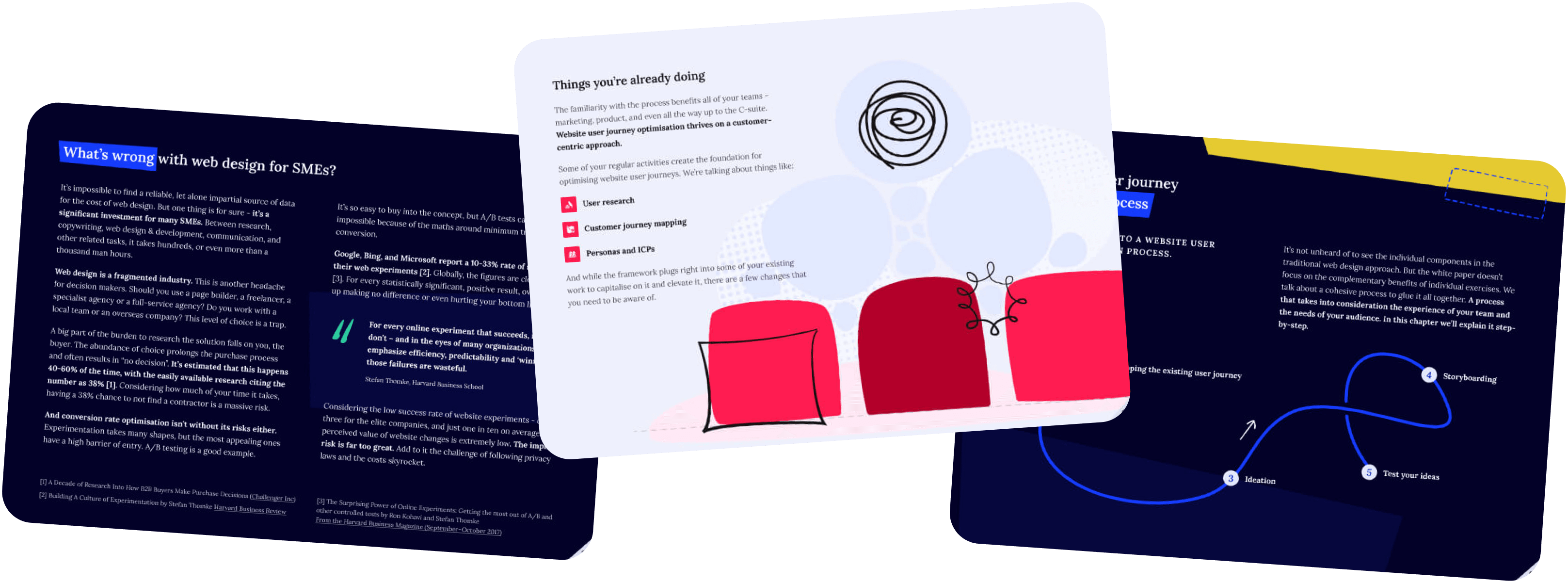


What’s inside
Discover the web design framework that:
Walks the walk on user-centric design.

Aligns stakeholders on website challenges.

Prioritises web design and development to reduce risk and maximise value for end users and your company.

Finds a balance between “design by a committee” and fully outsourced web design that doesn’t feel like it’s yours.


What is website user journey optimisation?
Website user journey optimisation (WUJO) is a web design framework that puts your end users, not your website, at the centre of every decision. Instead of asking “what’s wrong with our website?”, it asks “where do real people get stuck on the way to their goal, and why?”
Most web design looks inward. It fixates on page-level conversion rates, best-practice checklists, and redesigns that change everything at once. WUJO looks outward. It maps how people actually discover, learn about, and use your product, then fixes the specific points where they drop off.
For B2B SaaS teams, that shift matters. Your buyers research for weeks, loop in several stakeholders, and rarely follow the tidy “homepage to pricing to signup” path you imagine. WUJO is built for that messier reality.
Why traditional web design lets B2B SaaS teams down
A full redesign is one of the riskiest things you can do to a website, because three problems stack up at once.
It’s complex. Redesigns pull in conflicting opinions from every corner of the business, and long projects drift off course.
Too much changes at once. When everything moves together, you can’t tell which change helped and which one quietly hurt.
The outcome is out of your hands. You can’t reliably predict how a redesign will affect conversions, brand perception, or engagement. Digg is the cautionary tale: a redesign that broke its core user journeys helped hand the market to Reddit.
WUJO exists to take that risk off the table.
The five-step website user journey optimisation process
01
Stakeholder alignment
Websites usually get built in a silo, with marketing involved and almost everyone else shut out. The process starts with an alignment workshop that gives sales, support, product and the executive team a voice, then identifies and prioritises the real problems together.
02
Map the existing user journey
You plot your audience and their goals, then fill in how people actually Discover, Learn about, and Use your product. Mapping your prioritised problems onto that journey creates a heatmap of friction that exposes the genuine bottleneck, not the one you assumed was there.
03
Ideation
With the bottleneck identified, the team generates ideas to remove it. The rule is to look outward: draw inspiration from outside your industry rather than copying competitors, and treat every idea as worth hearing.
04
Storyboarding
You assemble the strongest ideas into a storyboard of the key journey stages. The job here is to patch gaps with solutions you already have, not to invent new ones or over-engineer the copy.
05
Test your ideas
Before anything ships, you put the concepts in front of real users. Testing doesn’t have to be expensive: in moderated sessions, three to five people each surface roughly a third of the usability issues, so a small panel goes a long way.
Who website user journey optimisation is for
WUJO works best for B2B SaaS and tech companies whose website has to earn its keep by bringing in leads. Most teams come to it in one of three moments: a new marketer has inherited a site that’s working against them, a funding round has left the website looking like a side project, or a pivot has moved the business on while the homepage stayed behind. If your buyers have a long, multi-stakeholder sales cycle, the framework fits.
Nothing to submit. Enjoy.


Frequently Asked Questions
Everything people have asked us about Website User Journeys before, during, and after workshops.

It’s a user-centric web design framework that maps how people discover, learn about and use your product, then fixes the specific points where they drop off, rather than redesigning the whole site at once.
CRO usually optimises individual pages through experiments like A/B tests, which need high traffic to be reliable. WUJO zooms out to the whole journey, across and beyond your website, so it suits B2B SaaS teams with lower traffic and longer sales cycles.
Mapping is one step within WUJO, not the whole thing. WUJO wraps stakeholder alignment, ideation, storyboarding and user testing around the map to turn it into actual website changes.
No. Because it relies on qualitative testing rather than A/B tests, it works for sites that don’t have the traffic to run reliable experiments.
The alignment and mapping work happens in a short series of workshops. Mapping should then become a regular habit, ideally quarterly, so the journey stays current as your product and audience change. You should also run the alignment part whenever the team is pulling in different directions.
More than just marketing. The framework deliberately brings in sales, customer support, product and the C-suite, because user needs only make sense in the wider business context.
Nothing to submit. Enjoy.